

Schreibst du noch oder tippst du schon?
... asked the FAZ in an article on January 14, 2015, which dealt with new curricula for Finnish elementary school. Minna Hermann, who drew up the guidelines at the Finnish Ministry of Education, believes that many children find it so difficult to connect individual letters on paper by hand that this leads to writer's block. The computer solves the problem and allows pupils to concentrate more on the content of what they are writing. For this reason, cursive writing should be removed from the curriculum in future and make way for typing on the computer.
When I read the article, I was horrified to wonder whether handwriting in general was to be scrapped. Skimming the article reassures me a little in this respect: handwriting will not be abolished from 2016; "only" cursive writing will disappear from the elementary school curriculum. It will then be up to the teachers to decide whether they want to continue teaching handwriting to their pupils.
Irmeli Halinen, Head of Curriculum Development in Finland, also supports this development:
Instead of learning to write, pupils should spend more time learning to type on iPads and computer keyboards. "They need time for that," she said. Many teachers have complained that boys in particular have motor difficulties when learning cursive writing. Even in the upper classes, this particular script requires a lot of practice(link).
Is print already the norm?
So it's about preventing writer's block and compensating for disadvantages due to poor motor skills? I have a son who has just finished elementary school and can confirm that handwriting is not one of his outstanding talents. He is also much more committed to using his iPad and keyboard than his fountain pen. So in a way, I can confirm the statements from Finland. However, I would never have come up with the idea of abolishing cursive writing, which is difficult to learn, or drastically reducing handwriting altogether ..... My experience is that you can write much faster with cursive handwriting than with block letters. I also wonder whether abolishing cursive handwriting is really the best way to counteract fine motor weaknesses. Wouldn't it be more consistent to promote cursive writing for this very reason?
But maybe my ideas are just antiquated? Are there also tendencies outside Finland to abolish handwriting or cursive in favor of the keyboard?
I start looking for more articles and find them surprisingly quickly:
- In Thuringia, for example, it has only been compulsory to learn handwriting in block letters since 2010. Teachers can decide for themselves whether they want to teach their pupils connected handwriting.
- Since 2011, elementary school in Hamburg have been free to decide whether they still want to teach traditional cursive handwriting or only "Grundschrift" (link), which is very similar to block letters.

Hamburg typeface from 2011
- British and Spanish school beginners also learn a type of printed script.
- In Sweden and England, schools can choose their own writing model, and in New Zealand, children write in block letters up to the fourth grade. "There is no evidence that people who first learn to write in block letters and then a joined-up script write more slowly," says Erika Brinkmann, a teacher at Schwäbisch Gmünd University of Applied Sciences(link to PDF file).
In Switzerland, too, I read, cursive handwriting is under attack:
"Swiss schoolchildren have been struggling with the "Schnürlischrift" for 67 years. It is standard in most of the 21 German-speaking cantons when writing papers. Now the cursive script is to be abolished, reports the "Neue Zürcher Zeitung" (NZZ). Both the majority of cantons and teachers want to introduce a basic script with unconnected letters instead, which is easier to learn(link).
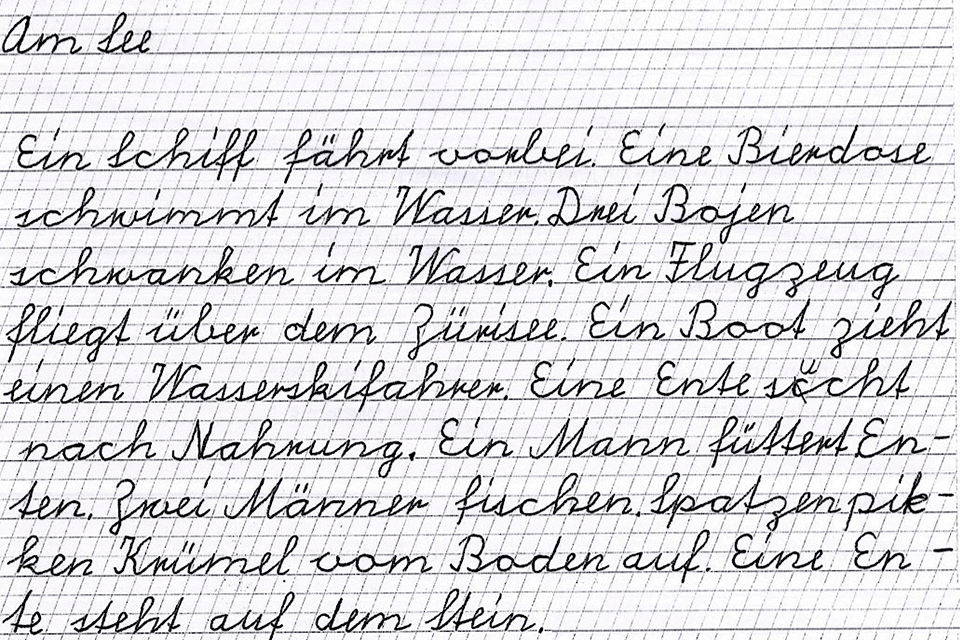
Connected Swiss school script ("Schnürlischrift")
Illustration: Adrian Michael, License: GNU Free Documentation License
Apparently, block letters have long been a reality in German schools - and not only there. What children see in writing is almost exclusively block letters, so when learning to write, children usually try their hand at large block letters first anyway.
In any case, the development towards print has obviously passed me by. How long has it actually been around?
How the basic script came about ...
It seems to me that a central element of the innovations is to simplify handwriting so that it is easier to learn and supports rather than hinders pupils in their writing. Efforts to simplify handwriting are nothing new. My son's handwriting is very different from the one I learned at the time: Many letters are considerably more "straightforward". I would now like to know more about this and am looking for the changes to cursive handwriting over the course of time.
I read with interest that Sütterlin was already endeavoring to rid the German Kurrent script of superfluous flourishes and to develop a script that was easier to write.

The German Kurrent script
Illustration: By Deutsche_Kurrentschrift.jpg: AndreasPraefcke derivative work: Martin Kozák (Deutsche_Kurrentschrift.jpg)
[Public domain], via Wikimedia Commons

The original German script according to Ludwig Sütterlin
Image: The Barbarian, License: CC BY-SA 3.0, via Wikimedia Commons
In 1941, the use of the old Fraktur typeface and, shortly afterwards, the Sütterlin typeface were banned. According to the propaganda spread by the National Socialists, the Jews had dominated the printing works and coined these letters.
For this reason, the German standard script was introduced in schools, a Latin script that replaced the Sütterlin script.
In 1953, the Iserlohn Writing Circle, an association of writing didacticians, developed the Latin standard script. They understood the process of writing as a movement and therefore emphasized the lively, rhythmic character of the script. The developers also wanted to counteract a decline in writing with the new initial script. The Latin alphabet was introduced into school lessons across the board by 1966.In West Germany, too, the Latin alphabet was revised at this time. Heinrich Grünwald was responsible for this. He criticized the inconsistent connections and the motoric difficulty of writing some letters in the old script. He carried out studies that initially proved his theory. The simplified original script has been taught since the 1970s. It was not until 1996 that the Oldenburg educational scientist Wilhelm Topsch refuted the studies and demonstrated some glaring shortcomings(link).
What glaring deficiencies are we talking about here? Mr. Topsch speaks of sampling problems, data changes, errors and unproven assertions. For example, the gender distribution was unequal (there were more girls in the group with simplified handwriting and more boys in the group with Latin handwriting), the pair formation was based on the variables of gender, pre-school education, social status and height; intelligence was not taken into account, the fluctuation of children was considerable, the published data was not uniform - to name just a few of the points of criticism.
Here you can find the complete text by Wilhelm Topsch.
Back to the basic font ...
At the end of the 1960s, elementary school were established as an independent form of school in West Germany. Cursive handwriting lessons disappeared from the curriculum and the above-mentioned Simplified Standard Script was developed, which was considered easier to learn.
In the 1980s, the view of learning to write changed fundamentally: children were initially allowed to write in block letters regardless of orthography. This made block letters the children's first cursive script and raised the question of the purpose of a second cursive script. The primary school association demanded in an article in 1997 that "the initial script must be the printed script!" However, as the term "printed script" is usually associated with printing processes, the primary school association introduced the term "basic script" as a handwritten form of printed script, and in Switzerland the term "basic script"(link to PDF file).

Font examples
Source: Grundschulverband e.V., link to PDF file
This brief overview of the history of school writing satisfies my curiosity quite well. However, I found a very detailed and interesting outline of the history of writing in Germany in this PDF file.
And what do the experts think about the basic font?
My son learned the "Vereinfachte Ausgangsschrift", which I don't think is so simplified, especially as the "z" in it looks rather old-fashioned and is obviously taken from the Sütterlin script. So there is still potential for simplification in this font ... isn't there? Allegedly, the "simplified original script" is already very close to the printed script (or so one reads, even if I don't think so). According to this, the logical step towards simplification, at least in terms of the available fonts, would actually be the basic font.
But does reducing to block letters really make things easier for pupils, as the study from Lucerne seems to confirm? Is it easier to learn print first and then a cursive script, or is it more laborious to begin with, but ultimately more successful in terms of acquiring the ability to develop a fluent and fast script? Do we still need this skill today?
Writing is something you learn in elementary school, so I looked for articles on this topic from the German Primary School Association. In an article from 2011, I read the following:
"At more and more schools in NRW, teachers are teaching first-graders the new, simplified script, which is based on block letters. Nationwide, there are already around one hundred schools that follow the recommendation of the Primary School Association and teach the new script. "Cursive handwriting is ballast that is no longer needed," says Ulrich Hecker, the second chairman of the German Primary School Association and head of a school in Moers. Children make their first attempts at writing in block letters anyway. It is not until second grade that one of the three standardized initial scripts is added. "Then the children are just able to read and write fluently and have to get used to it again," says Hecker. "We can spare children this detour." Primary school children need around nine months to learn cursive handwriting after learning block letters. According to the association, this time could be put to better use. "For spelling, lots of reading, as specified by Pisa, and grammar," says Hecker."
"Cursive writing no longer plays a role in everyday life, says Bertling. "Most of what we write today is typed - and we see it in print," says Bertling. "In terms of both writing and reading, old handwriting is something almost exotic(link to PDF file)."
We hear from Switzerland:
"Basic handwriting makes it easier for pupils to develop their individual handwriting," Beat Zemp, President of the Swiss Teachers' Association, told the Swiss newspaper "20 Minuten". Handwriting is still important today, even if its significance has diminished due to digitalization. According to the plan, pupils should initially learn the letters individually, and from the second or third grade they should begin to connect them(link).
A study, also from Switzerland, seems to confirm Beat Zemp's statements:
In a study, researchers at the University of Teacher Education of Central Switzerland in Lucerne compared the writing motor skills of 93 fourth-graders, roughly half of whom had been taught in one of the two scripts.
"This confirmed that children taught in basic script can write faster and yet more legibly than with the old Schnürli script," says study director Sibylle Hurschler.
In addition, the otherwise clear difference between girls and boys in writing performance in basic handwriting had disappeared(link to PDF file).
"The primary school association rates the experiences to date at around 50 elementary school so positively, even without a strictly scientific evaluation, that the recently launched campaign now wants to encourage teachers nationwide to try out primary school handwriting(link to PDF file)."
Admittedly, I think the cursive script that is developed from the basic script is quite nice; and if the path to it via the basic script makes things easier for the children, there seems to me to be nothing wrong with it - provided that advanced writing with connections is actually taught.
Do other agencies see it as positive? Not at all. In the "Welt" you read:
"The effects cannot be determined by short-term observations, but only over several years. This did not happen. Instead, the experiment is carried out on living subjects without in-depth knowledge of the process."
According to this article, there is also evidence that learning connected handwriting has a positive effect on children's language and spelling skills:
Professor Bredel, whose research focuses on orthography didactics, points to studies that suggest that handwriting is a "comotor" process" in which individual letters are not written in isolation, but rather sequences of letters that correspond to linguistic units. Connected scripts therefore enable pupils to learn linguistic units as connected units(link).
The Philologists' Association is also critical of the move away from handwriting. The association's chairman, Heinz-Peter Meidinger, calls for the decline of handwriting to be counteracted:
Learning bound handwriting is an elementary individual learning process for every child. It promotes the flow of thought. Meidinger believes that the abolition of handwriting would ultimately lead to general educational poverty.
Educational scientist Prof. Renate Valtin from Berlin's Humboldt University, on the other hand, says that handwriting is indispensable, as handwritten notes make it measurably easier to understand the content of a lecture and keep it in your memory for longer. However, Valtin does not believe that connected handwriting is necessary(link).
Werner Kuhmann, psychologist and educational scientist at the University of Wuppertal, also advocates the preservation of cursive writing:
"Cursive writing as a standardized combination of individual letters is a cultural asset that requires practice. If you don't give pupils enough time and space for this, you can't be surprised if they have difficulties."
According to Regine Schwarzhoff, Chairwoman of the NRW Parents' Association, the abolition of cursive writing not only deprives children of a personal way of expressing themselves, but also of one of the basic cultural techniques that should be taught in elementary school.(Link to PDF file).
The Munich writing expert Ute Andresen also has less than kind words for the new basic font:
"Empty promises, wrong thinking and misleading!" says the teacher. The original script needs detailed forms and connections that can later be individually simplified. "The individual letters must be able to change smoothly depending on where they are inserted. This is the only way to make writing fluent," explains Andresen. In Andresen's view, problems with learning cursive writing arise primarily when pupils have already acquired unfavorable movement patterns with print writing. "The basic handwriting concept, however, allows children to develop and maintain idiosyncratic movement patterns," criticizes Andresen. Children could learn cursive handwriting within three weeks if they practiced the block letters in a binding line pattern(link to PDF file).
Guido Nottbusch, professor of primary school education at the University of Potsdam, on the other hand:
"Some letter forms in the older school scripts are very complicated. If you look at the capital H in the original Latin script, for example, no one will write it as an adult in the same way they learned it as a child. For me, it's important that the writing is as easy to learn as possible and that the children gain a high writing speed as quickly as possible. Because if you write quickly, you can get your thoughts down on paper faster and have more time to think about what you are writing. Of course, it is also important that it is legible, because otherwise I don't need to write at all."
He remarks on the importance of cursive writing:
"There is a Canadian study in which three groups were examined. One group learned a cursive script from the start, the second group learned a print script and the third group first learned a print script and then a cursive script. In the end, it was found that the children who had switched once had fallen behind in terms of performance. So learning again takes time. Those in favor of the switch say: Yes, but it's worth it to us. You can't say too much against it either. After all, the children deal with the letter form again and perhaps learn it more intensively as a result. But of course you can also use this time differently(link)."
I have to confess that my research tends to reinforce my opinion in favor of preserving cursive writing (although unfortunately I'm not in a position where I could achieve anything with my plea ...). However, I agree with Guido Nottbusch: I consider being able to write quickly to be the most important learning objective when learning to write, if you disregard the cultural aspect.
... or would you prefer the children to type?
Now that I think I have gained a good overview of what speaks for and against cursive writing, I would like to turn to another aspect that is mentioned in the article about Finland: the focus when writing should be more on working on the computer, more typing and less handwriting.
In Germany, too, there are calls for increased digitalization, as German pupils are only in the middle of the field in terms of media literacy in an international comparison(link).
Working more with electronic media prepares students for media literacy. However, media literacy involves much more than just being able to type quickly or operate a tablet. What measures are involved in teaching pupils media literacy? When does it make sense to start teaching children how to use media? It would be interesting to go into this topic in more depth ... but I won't at the moment. Now that I've read a lot about handwriting and print, I'd like to take a closer look at the handwriting versus computer aspect: How far has the displacement of handwriting by tablets and computers progressed?
I quickly find what I'm looking for in the neighborhood:
There are now more than twenty so-called Steve Jobs schools in the Netherlands, where iPads replace textbooks and exercise books from the first grade onwards. Between 70 and 80 percent of lessons at these schools are taught using iPads(link).
Mr. de Hond emphasizes that apps make learning more inclusive and justifies the very strong digitalization with the fact that generally very little is still written by hand - according to him, only around four percent of letters in the Netherlands are still handwritten.
How do experts assess digitalization in schools? I discover a book on this topic: "The lie of digital education. Why our children are unlearning" by Gerald Lembke and Ingo Leipner.
This book criticizes the ongoing digitalization of German schools. Lembke is Head of the Digital Media course at the Baden-Württemberg Cooperative State University in Mannheim and President of the Federal Association for Media and Marketing. He is of the opinion that freeing children's learning process from computers disproportionately promotes media skills from the age of twelve. According to him, only then are children neuroscientifically and developmentally mature enough to use computers in a targeted manner for a learning process. In an interview with Matthias Kohlmaier from the Süddeutsche Zeitung, he comments:
"If a child can use an iPad really well at the age of eight, they may have a high level of wiping skills, but that has nothing to do with media literacy. When children use smartphones, tablets and the like, they use them completely out of context - not with the aim of acquiring and utilizing knowledge. Media literacy only develops when pupils are mature enough to understand what is happening on the colorful screen in front of them, and when they receive targeted support in the use of digital tools in education(link)."
At the University of California Los Angeles, I read elsewhere, experiments were conducted to compare the learning effect of taking notes by hand and by keyboard. The results showed that the test subjects who took notes by hand remembered the content of lectures much better than those who used a laptop.
However, the lead author of the study, Pam Mueller, a psychologist at Princeton University, also notes:
"I don't see us getting a lot of people to go back to the notepad."
However, there are now various new technologies with tablets and electronic pens that could perhaps make use of the handwriting effect so that note-taking is done more consciously than on a laptop. For optimal learning, you have to be forced to process the information as it arrives rather than writing it down mindlessly(link).
In digital terms, the USA is probably leading the way. And since the study was conducted in Los Angeles, I am now looking at the status quo there:
"A massive expansion of classroom technology has come to a grinding halt in Los Angeles. The LA Unified School District had planned to buy some 700,000 iPads for its students and teachers. The Apple tablets would include learning software built by publishing giant Pearson(Link)."
However, the project failed due to extremely high costs, the lack of training opportunities for teachers and the fact that the software did not work flawlessly.
My gaze falls on the number of iPads that were planned: 700,000! While reading this, I hadn't even realized what a gigantic market the digitalization of teaching opens up for tablet and laptop manufacturers, especially as laptops and tablets are probably not only bought once per school career. This means huge business for manufacturers. In Germany alone, there were 11 million pupils in the 2014/2015 school year (source: Federal Statistical Office).
Olaf Kleinschmidt, a school consultant and teacher, also sees it this way: according to "Pisaversteher", he calculated that fully supplying pupils throughout Germany with a tablet would cost almost seven million euros, not including updates. And yet, as I read, he is not an opponent of digitalization in principle:
"In principle, there is nothing wrong with schools purchasing more computers. The digitalization of schools is unstoppable anyway. There are already some exciting learning projects: whether it's cooperation between pupils via learning platforms and blogs or learning apps, such as those that can be used to create work documentation as e-books with film, images, graphics and sound. So far, however, the project "Tablets for every pupil" and Learning 2.0 has not progressed very quickly. Abolishing cursive handwriting would solve this bottleneck in an almost brutal way - it would act as an accelerant for the tough German debate(link)."
I think that the increasing digitalization of schools, even if it still seems to be progressing slowly in Germany at the moment, cannot be stopped. Apart from pedagogically sophisticated learning apps and learning platforms, the internet offers a gigantic pool of knowledge. Dealing with this and evaluating information is certainly an important learning objective, and a study by the University of Hamburg at a grammar school also confirms this,
"... that the school-related media use of all participants has intensified in the course of the project. This applies above all to the already frequently observed media practices of researching, reading and editing texts and presenting work results. In this context, it seems to be particularly relevant to be able to access the tablet spontaneously at any time, e.g. during lessons, to look something up briefly during the lesson and to use it to make a statement(link to PDF file) ...
However, I would consider it a serious mistake to subordinate learning as a whole to digitalization - digital media should support and accompany learning, but not dominate it.
Another aspect that somehow seems to be overlooked in the media discussion is the financial burden on parents who have to buy tablets and notebooks for their children. For many households, these expenses are difficult (if not impossible) to bear.
Back to handwriting and cursive writing. At first glance, "marrying" iPads with handwriting seems to be a practical solution: You work with an electronic medium and still take notes by hand, thus taking advantage of all "media". However, I am not sure whether this is a practicable approach. The above-mentioned study by the University of Hamburg shows that this approach is not the first choice, at least not for all pupils:
"While reading on the tablet seems to be relatively unproblematic, with a few exceptions, writing on the device is highly ambivalent among both young people and teachers."
"Some switched a large part of their personal information management to the use of digital media. In some cases, however, the students returned to increased use of analog media after a trial phase for various reasons. Others also pointed out that they preferred working with analog media to working with digital media (especially reading and writing or annotating on paper). However, it remains to be clarified whether this is a general preference in the sense of an orientation or attitude independent of school practice, or whether these preferences are the result of years of habituation."
I also wonder whether it will ever be possible to read across a screen as quickly as in a printed document, as it is not as easy to scroll electronically. There are certainly already studies that prove or disprove this. However, I will not pursue this topic any further at this point.
However, I am sure of one thing: to learn spelling, you have to write by hand - without the autocorrect function. Exceptions prove the rule: for dyslexics and people with severe visual impairments, autocorrect, magnification options and other support functions are simply a blessing. However, typing does not promote fine motor skills and dyslexics are deprived of the opportunity to counteract their writing weakness.
Do we need handwriting? In order to benefit from the advantages of handwriting, at least one thing is essential: You have to be able to write quickly. Cursive handwriting makes it possible to write much faster than basic handwriting by connecting the letters. Perhaps even more important to me is the perception of connected letter sequences as linguistic units. Unfortunately, I was unable to find out whether the subsequent joining of the letters in the basic script also results in a joining to form linguistic units or whether the joining is prevented by the upstream basic script. The future will show whether the basic script model proves its worth.
There is still a lot to read and write about the digitalization of schools and media lessons. Media literacy is not just about being able to type and research well. Media literacy also means being able to put aside electronic media, developing a sense of quality, not allowing oneself to be bombarded at all times and with every offer and developing a balanced relationship between communication via media and direct exchange with the other person. That would be worth an article of its own.
Cover picture: Ministerio de Educación, License: CC BY-SA 3.0-igo, via Wikimedia Commons






So I, a pensioner, gave up cursive writing as soon as I was allowed to. So I can still read a lot of the things I wrote AFTER I left school, which was only ever possible in exceptional cases with my cursive handwriting.
The advantages of print as the only handwriting are therefore clear to me. Writing faster, even if it works for some people, is of no use if you only have the choice of writing slowly(er) or quickly(er) and ultimately writing uselessly.
Should you type right away? Sometimes yes. More importantly, a computer today can usually read passable (handwritten) print, but proper handwriting recognition is still in its infancy. If it goes beyond notes for short-term, one-off use, such as shopping lists, if something of lasting value is to be created, handwriting is a suitable handwriting - cursive has to be typed later!
Is a valuable cultural asset being lost with cursive writing? Is it bad that you (probably) can't saddle a horse or hitch up a cart? Is it a loss if hardly anyone spins yarn themselves and then knits socks?
If there is a loss, it is of a different kind: children who do not learn to write cursive will also have difficulty reading it. Reforms have always caused such problems. Who can read Sütterlin? Is that a bad thing? Who can read runes? Is that a bad thing?
Time does not go backwards. We old people have to live with many of the economic necessities that will shape the whole life of the new generation - or be seen by the young as the obstacles we would then be. I don't depend on young people crying after me in my old age one day, but if they were happy to have me off their backs, I would have done something wrong.
Advertising and trademarks will adapt. There are some beautiful typefaces that simulate handwriting (Pacifico, Lobster etc., the aforementioned even with a uniform style for Latin and Cyrillic letters!), but an unmanageable selection for print. Coca-Cola will survive being sold in legibly labeled bottles for the generation after next!
Hello Mr. Jansen,
Thank you very much for your detailed comment and your comprehensible views.
Best regards from Dortmund
Thank you very much for this article. My child started school this year and I am trying to find my way around today's school, which differs quite a bit from my (remembered) school days. For example, I didn't know that cursive writing is no longer taught in NRW.
I don't believe that handwriting with joined letters will develop so easily from basic handwriting! However, my opinion is based more on anecdotal, personal experience.
I learned basic Latin script and instead of 1 A4 page (my child) I had to fill out a whole booklet with handwriting exercises (which I hated because it never, ever looked like the template). My personal handwriting developed so-so from this. But I only felt at home in my handwriting when I had written pages and pages (almost) every day: 3 pen pals and a diary. I can see from the diaries that my handwriting only became "mine" after about 1.5 years.
My child will probably not have these opportunities to practise (writing exercises at school are also no longer possible because everything has to be copied and no longer copied).
My child doesn't like writing, but the only thing that will help is more writing :)
Hello Mrs. Reemann,
Thank you for your very interesting comment and all the best for your child's exciting time at school.
Yours sincerely from Dortmund
A very interesting article and thank you for all the information.
Are there really enough studies that clearly prove that the new "Grundschrift" is really to be recommended?
The fact that it is up to the teacher to decide what kind of handwriting the children should learn is, for me, a declaration of bankruptcy by the ministries of education. School experiments should be a thing of the past.
I am an advocate of learning a sensible cursive script, such as the "basic Latin script".
https://de.wikipedia.org/wiki/Datei:Lateinische_Ausgangsschrift_1953_plain.svg is described.
This script should not be graded, because it can also be changed individually (later), just as we all do with cursive writing.
This MUST be secured in writing, because not everyone MUST have a computer.
In other words, everyone must have a basic right to learn (individual) handwriting.
If we continue to chase after "the digital prophets", the result will be that NOBODY can/must speak and write German correctly any more. We no longer need books either.
Teachers should also know that they will soon be replaced by computers - if we take the possibilities of "digitalization" seriously and don't take countermeasures early on.
Such as the right to individual handwriting.
Mr. Lesch's article ruthlessly reveals that digital learning is not beneficial for children's intellectual development. Block letters are (quasi) digital.
https://www.zdf.de/wissen/leschs-kosmos//digitale-revolution-die-zukunft-des-lernens-100.html
Another question :
Is there already a German politician or scientist or teacher who signs with basic handwriting?
The Ministry of Education should think about it.
Grundschrift is a development of the Grundschulverband. In a publication, the association writes that it creates individual and legible texts. The argument that the connection between the letters is missing and that this affects the writing speed is countered by the fact that connections are not necessarily visible on the paper, but that the momentum can still be seen on the paper. However, there seems to be a move away from this in the meantime - at least there are efforts to teach connected handwriting again. But there doesn't seem to be a real consensus on this yet and overall it seems to me that the debate is characterized more by ideologies than by solid scientific findings. I have researched studies, but both sides attest to the lack of scientific validity of their theses.
My personal theory is that there is probably no simple answer because the writing that is taught is only one of several factors that influence how well, legibly and quickly a person later writes. General motor skills and practice also play a role - and these are often neglected because people write much less than they used to and type much more and from a much younger age. In my opinion, the key lies less in the type of writing that is taught and more in the frequency of use. Perhaps this also reflects my aversion to ubiquitous digitalization and my view that manual learning is being neglected overall - in my opinion, this is fatal for children's development.
However, I wouldn't go so far as to regard block letters as digital. What a letter, a word or a sentence represents in the brain, whether and with which images it is internally linked, is connected to more than the letter as such. Painted and decorated, for example, the digital is no longer digital at all.
So much for the theory. Personally, I find that (contrary to the statements of the primary school association) the use of block letters has a considerable effect on writing speed and that separating the letters leads to them coming more to the fore than is the case with joined writing. From this, one could deduce that this could also have a negative effect on the inner "wiring", which supports Mr. Lesch's statement to a certain extent.
Is there a fundamental right to learn handwriting? I don't know. At the very least, I believe that it is our duty as parents and other people responsible for education to provide our children with as broad a spectrum of learning as possible and I find it worrying when the focus is only on digital skills.
A signature in basic handwriting would probably mean the premature end of every application ;)
Some time ago, a colleague told me that handwriting is nonsense because typing is faster. That sounded plausible at first, but when I questioned it, it turned out to be simply wrong: http://www.draketo.de/licht/ideen/steno/ist-tippen-schneller
Handwriting can be optimized in several steps, and people who have still learned shorthand achieve twice as high typing speeds as people who type on a keyboard. The fundamental flaw in the idea of faster typing is that like is not compared with like: Typically, long-schooled typists compare their typing speed to the speed of their own often fallow handwriting and not, say, to the handwriting of people who have optimized their handwriting for speed.
However, shorthand also shows that abbreviations that have been planned and developed over centuries are far more efficient than those invented by the user, because self-invented abbreviations can easily lead to dead ends in which the handwriting can no longer become faster without becoming illegible. The same is likely to happen with the poorly guided development of cursive handwriting from a printed script.
Dear Mr. Babenhauserheide,
I also know a few friends of shorthand. The speed really can't be beaten, and in particular you don't have to rely on functioning electronics. From my point of view, however, shorthand has two disadvantages: First, only those who are proficient in shorthand can read the text, and not many of them are. Secondly, shorthand is unbeatable in terms of speed, but ... beautiful is different. Apart from the function of writing to capture information, the aesthetic aspect also plays a role for me: a curved script, ideally written with a fountain pen, simply looks nicer than stenographic abbreviations.
There is another argument for writing on a computer that cannot be dismissed, namely the fact that texts can be corrected. When I write professionally, I always write at the keyboard for this reason. In my private life, on the other hand, I have increasingly returned to writing by hand and enjoy experimenting with fountain pens and nibs.
Best regards
Eva Weber
Hello Mr. Taubert,
thank you for the link to your extremely informative site!
Best regards
Eva Weber
Das Grundschrift-Konzept erweist sich in zentralen Aussagen als wenig elaboriert, empirisch zweifelhaft abgesichert und mehr durch pädagogisches Wunschdenken als durch rationale Analyse oder gar gesunden Menschenverstand geleitet. Nähere Informationen unter .
Dear Eva, the tendency is towards good old dictation :) I hardly write any more, dictate almost everything thanks to Dragon Naturally Speaking and everything is fine.
As long as the technology works ;)
Very informative,
perhaps cursive writing will be as antiquarian for future generations as "chiseling in stone tablets" is for us.
MfG
... or the writing itself. "What, they used to write?" The trend seems to be towards voice input.
Best regards
Eva Weber