

In the future, industry and commerce will be required to provide a Digital Product Passport (DPP) for products placed on the market. This requirement is based on the new Ecodesign Regulation 2024/1781, which mandates that manufacturers collect and publish comprehensive data on each product.
The introduction will begin as early as February 2027: the first products, such as textiles, must then be equipped with a digital product passport.
Uniform implementation through standardization necessary
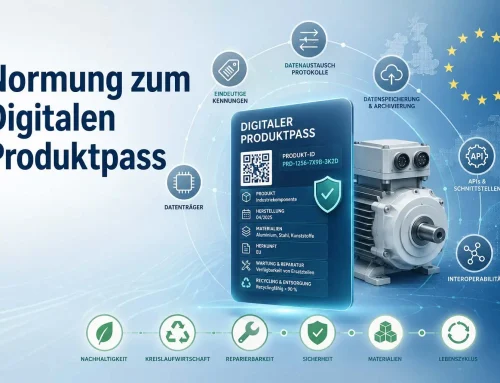
This raises the question of what content the product passport should include and how data and interfaces should be designed. A standardized approach is essential to ensure the simplest and smoothest possible implementation.
For this reason, the European Commission has commissioned the European standardization organizations CEN, CENELEC and ETSI to develop harmonized standards for the digital product passport. At the same time, the German standardization organizations DIN and DKE have founded the "Digital Product Passport" committee to reflect the work at national level and represent German interests in Europe.
First draft standards at a glance
The activities are coordinated by the DIN standards committee NA 043-02-06 GA. Over the past two months, several draft standards have been published there that deal with different requirements for the digital product passport.
Examples of current draft standards:
| Standard | Title | Topic |
|---|---|---|
| DIN EN 18216 | Protocols for data exchange | Describes secure and efficient data exchange protocols and data formats for DPP data. |
| DIN EN 18219 | Unique identifiers | Defines guidelines for unique product identifiers, unique economic operator identifiers and unique facility identifiers. |
| DIN EN 18220 | Data carrier | Defines requirements for data carriers used in a digital product passport system. |
| DIN EN 18221 | Data storage, archiving and data persistence | Defines requirements for decentralized data storage, archiving and data durability of digital product passports. |
| DIN EN 18222 | Programming interfaces (APIs) for life cycle management and searchability of the product passport | Standardizes APIs for data access and searchability of DPP. |
| DIN EN 18223 | System interoperability | Deals with the overarching interoperability between DPP systems. |
| DIN EN 18239 | Management of user rights, IT security and business secrets | Defines the requirements for the access rights management of the DPP. This includes IT security, data protection and the transfer of responsibilities from one economic operator to another. |
| DIN EN 18246 | Data authentication, reliability and integrity | Defines requirements for secure information processing and communication to ensure the integrity, authenticity and reliability of exchanges. |
Still unclear contents of the product passport
From the titles and topics of the draft standards to date, it is clear that the current focus is on ensuring data retrieval and exchange of the DPP. However, these standards do not deal with the specific content.
While it is helpful to know how data must be provided, it is equally important to have clear guidelines on what information should be included in the DPP. This is precisely where there is currently still a lack of clarity.
The Federal Ministry for the Environment defines the content as follows:
"The digital product passport is a data set that summarizes the components, materials and chemical substances or information on reparability, spare parts or proper disposal for a product. The data originates from all phases of the product life cycle and can be used in all these phases for various purposes (design, manufacture, use, disposal)."
So much for the official statement - typically regulatory, but only of limited help in practical implementation.
Possible contents of a DPP
After evaluating various sources, the following information could be part of a DPP:
- Technical data: Product name, model and serial number, technical specifications
- Materials and ingredients: composition, raw materials used, recyclability
- Origin and supply chain: production data, locations, transportation routes
- Sustainability: carbon footprint, environmental certificates, information on sustainable procurement
- Use and maintenance: instructions for use, maintenance instructions, safety information
- Repairability and spare parts: Repair options, availability of spare parts, expected service life
- Disposal and recycling: Instructions for proper disposal and recycling
- Conformity: Certifications and proof of compliance with standards
Depending on the product, further information may be added. It would therefore be helpful if standardization were to provide product-specific information on DPP content in the future.
Example: The digital battery pass
An illustrative example is the digital battery passport, which is prescribed by the current Battery Regulation (EU) 2023/1542. It must be available for certain batteries from February 18, 2027. The first implementations, which can already be found on the internet, can serve as a guide.
Conclusion: Familiarize yourself with the requirements now
Even if 2027 still seems a long way off, implementing the necessary interfaces and data formats is time-consuming. The deadline will therefore be reached sooner than you think.
Even if the standards mentioned have only been published as drafts so far, it makes sense to look at the content now. After all, the general direction is unlikely to change.





Leave a comment