
… oder was muss ich beachten, um „europäische“ Anleitungen für den US-Markt tauglich zu machen
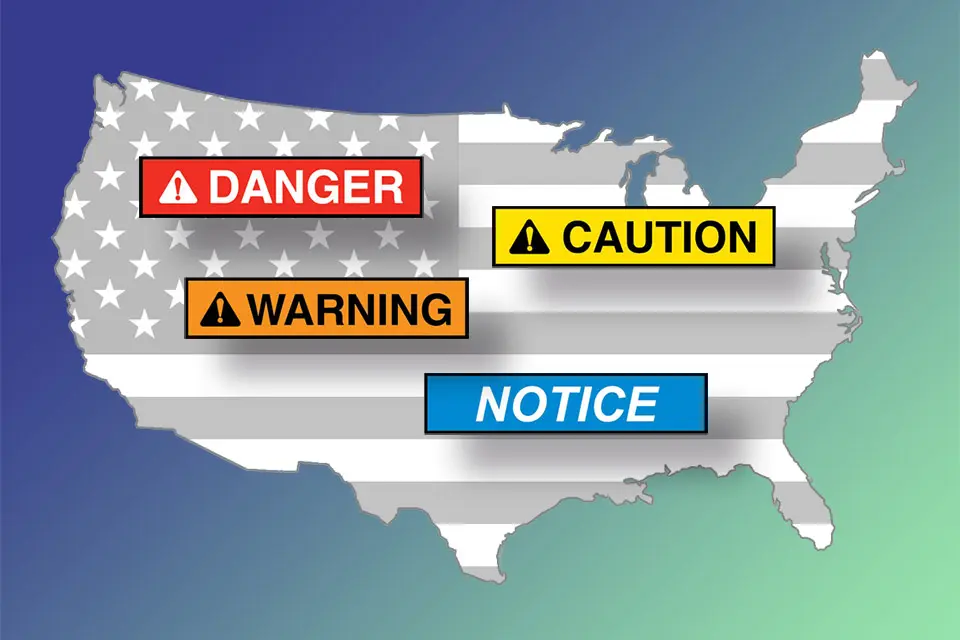
Die ANSI Z535.6 schlägt ein Regelwerk für die systematische graphische Gestaltung von Sicherheits- und Warnhinweisen in der technischen Dokumentation für den US-Markt vor.
The document is normative in nature ("The Z535 Committee recognizes that this information [communicating safety and accident prevention] can also be effectively communicated using other graphic systems," page VII, third paragraph), but it is no more binding than European standards ("The use of American National Standards is completely voluntary ...," page II, third paragraph).
The set of rules therefore describes a possible way of solving problems. And there is no reason not to use this work as the basis for your own safety and warning notice system—in other words, to apply it to your own documentation. However, "applying" does not mean slavishly adopting this system.
apparent problems
Time and again, the use of ISO pictograms is questioned in the "application" of ANSI Z535.6. Apart from the fact that this topic is not addressed at all in this part of the standard—which deals with the hazard levels Danger, Warning, Caution, and Notice, their definitions, and their clear application—the question arises as to how productive such discussions are.
It would certainly be unfortunate if the pictograms were misunderstood by the target group – however, the examples often cited seem to be very sensationalist (example: in China, the sign for wearing ear protection would be interpreted more as a requirement to wear earmuffs... Incidentally, what does China have to do with the US market?)
Solution approach: Combination of ANSI and IEC 82079-1
The main focus should be on combining the ANSI proposals with the internationally valid IEC 82079-1 standard and using this to develop a separate documentation concept. This should, of course, also include a concept for presenting safety and warning notices in your own documentation.
The view that ANSI Z535.6 alone is not sufficient is also shared by Dr. Mathew Kundiger, incidentally one of the co-authors of this standard, in a discussion paper published by the VDMA in December 2008. In it, Kundiger emphasizes that the primary focus must be on the comprehensibility of the instructions in order to succeed in the US market. Deficiencies repeatedly arise from a lack of target group analysis, with the result that the safety information contained in the instructions is not adequately provided and the procedures are incomprehensible or too brief.
Technical writers must therefore never lose sight of the target group's need for information. The key to ensuring that information is understandable and easy to find is a clear and comprehensible structure, such as that proposed by IEC 82079-1, which is based on the product life cycle. Based on this structure, the various semantic elements—such as descriptions, notes, or instructions—must be clearly defined and delineated. The relevant information must be prepared in a manner appropriate for the target group. In addition to short and understandable wording and the obvious requirement for accuracy, it is essential that the information provided in such semantic elements is self-contained.
Whether the level of detail needs to be adjusted again for the US market depends on whether and how the target groups in Europe differ from those in the US. It should then be no problem to replace one or two semantic elements with a market-specific variant. All without having to change the basic structure of the document in question.
Another point is the quality of the translations. Here, both the terminology used by the manufacturer/distributor and the language (US English, or even Mexican Spanish, if applicable) should be specified to the translator. This requirement also applies in Europe, albeit in other languages, of course.
The third point is to provide evidence in the event of legal proceedings that everything possible was done to prevent personal injury from the outset. The evidence is based on the existing risk assessments and the documentation concept. And what better way to substantiate such a concept than with a comprehensive editorial guide?
Summary:
These requirements are actually old hat and should apply across the board, regardless of the market for which the product is manufactured. Well-written instructions that comply with European standards should therefore also be suitable for the US market .
It should actually be standard practice to critically review the depth of the information provided on the basis of your own target group analysis for each market addressed, especially the US market, and to adjust it if necessary. Whether this analysis has to be carried out anew for each individual case or can be done conceptually a priori depends on the heterogeneity of the products.
A clearly designed instruction manual that is consistently implemented is therefore the best guarantee of minimizing potential vulnerabilities.
Authors: Holger Brüning, Olaf Dömer






Thank you very much for this article. To your knowledge, are there any recommendations or experiences with contradictions to WCAG guidelines? In particular, I am referring to the sometimes insufficient contrast between text color and background color. While the WCAG guidelines prescribe certain contrast ratios, those specified here in ANSI Z535.6 are sometimes insufficient. However, both sets of rules should apply, especially in the US.
I would be happy to discuss this further.
Due to the complexity of the issue, we clarified it over the phone. I hope I was able to help Ms. Markworth.