
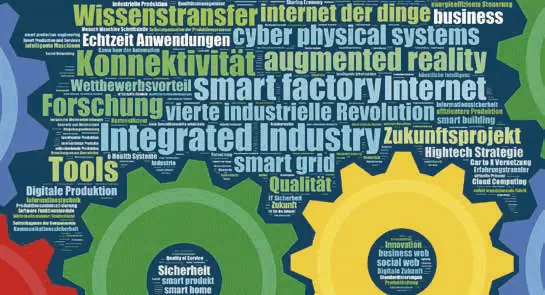
Kennzeichnend für die digitale Industrialisierung ist die starke Anpassung der Produkte unter den Bedingungen hoch flexibilisierter Produktionen. Die notwendige Automatisierungstechnik soll durch die Einführung von Verfahren der Selbstoptimierung, Selbstkonfiguration, Selbstdiagnose intelligenter werden und die Menschen bei ihren zunehmend komplexen Aufgaben besser unterstützen.
Information such as status information, descriptions or instructions will play a major role in the future alongside the actual product function. This information will be called up and made available by sensors, actuators and beacons. In contrast to current technologies, information will be made available from the so-called Internet of Things in the future. Both component manufacturers and the manufacturers of products that use these technologies are currently working on viable concepts. At the same time, companies are waiting for the necessary political decisions, such as on data security and the development of the necessary transmission technologies to ensure high-speed data transmission.
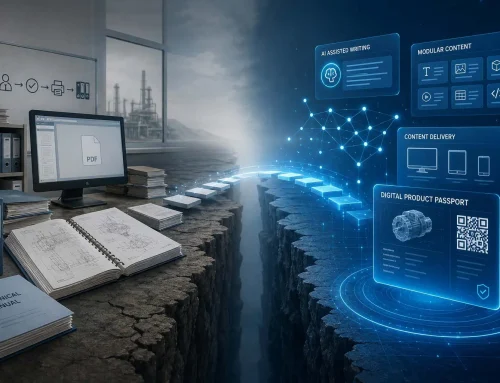
The Internet of Things will play a key role in this context. In future, all information will be found in this virtual world, including the information products of technical communication. These information products must be prepared accordingly in terms of both content and organization.
State of the art in technical communication
Unabhängig vom Thema “Industrie 4.0” hat sich die Technische Kommunikation in den letzten Jahren bereits sehr intensiv mit folgenden Themen auseinandergesetzt:
- Standardization of information
- Universal applicability
- Automated creation and distribution of data
- Guarantee of retrievability/identification
- Language-independent or machine translations
As technical communication has always struggled with the shortcoming of non-profitability, the reasons for these developments are more of an economic and organizational nature. However, the advance of big data may lead to a change in values here.
Technical communication faces a special task here. The skills gained in recent years, coupled with the appropriate tools such as editing systems, translation memory systems, terminology tools, etc. and additional meaningful integration into companies' production processes, make it possible to do justice to the growing diversity of information.
Guarantee of retrievability/identification
Nicht der PC oder die DVD wird zukünftig die Information bereitstellen, sondern das “Internet der Dinge”. Metadaten, Taxonomien sowie die Modularisierung und Standardisierung von Informationen erlauben es selbst noch so kleine Informationseinheiten wiederauffindbar zu machen. Ob Dita, docbook oder PI-Mod, eine Standardisierung wird hierfür zukünftig unumgänglich. Wichtig ist hierbei eine gemeinsame Sprache zu finden, da nur so ein konsequenter Datenaustausch möglich wird. Dass so etwas in gewissen Grenzen möglich ist, hat uns die Automobil- und Rüstungsindustrie in den letzten Jahren bereits gezeigt. Dies wird in naher Zukunft noch eine große Herausforderung für alle Zweige der Industrie werden. Offen ist auch noch, ob ein bestehender Standard zum Einsatz kommt oder ggf. ein neuer Standard entsteht.
And in which language do I make my information available?
A lot will change here too. There are already some useful approaches that point in the right direction. Translating texts or information manually could soon be a thing of the past. Translation memory systems, terminology tools, language checkers, etc. are already helping technical authors to create consistent content, which in turn can serve as a good basis for machine translation. The foundations laid years ago for machine translation processes will ensure that information can be switched to the required language online in the future. Manual translation will then no longer be necessary.
What are the benefits of this?
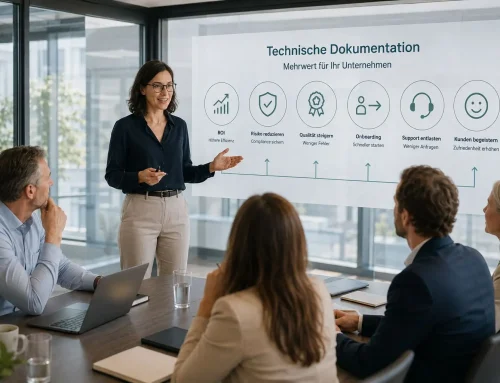
The design of target group-oriented, comprehensible information is already the concern of many well-trained technical editors today. Keywords such as usability are becoming increasingly important. And it is precisely those groups of people and companies that manufacture, operate, repair and maintain products that benefit from this. Downtimes are reduced, operating errors are prevented, cost-intensive service calls are avoided and incorrect orders for spare parts are reduced.
Here are some scenarios that are already possible from today's point of view, but will become much more prevalent in everyday life:
- In future, service technicians will benefit from up-to-date and filtered information (tailored to the respective configuration). Additional technical aids such as digital glasses allow service technicians to work freely.
- Operators can be provided with more or less information depending on their qualifications.
- Product information is presented in the user's preferred language.

Leave a comment